Sobre este puesto de TERMS OF REFERENCE (TOR) FOR ETHIOPIA: MARKET SATURATION ASSESSMENT en Inkomoko
ABOUT INKOMOKO
Inkomoko supports entrepreneurs to grow their businesses in order to improve livelihoods, create jobs, and help communities thrive.
In 2026, Inkomoko was listed by the Financial Times as the 5th fastest-growing company in Africa, supporting entrepreneurs across East and Central Africa to grow thriving businesses and build inclusive, resilient economies.
Founded in 2012, Inkomoko has worked with more than 120,000 entrepreneurs, including thousands of refugee entrepreneurs. Inkomoko provides a combination of training, consulting, access to finance, and market-level systems change. We are the largest investor to refugee entrepreneurs in Africa.
Inkomoko has 1,000+ staff in 50 offices across Chad, Ethiopia, Kenya, Rwanda, and South Sudan. Through Inkomoko’s 2030 strategic plan, we are adding 3 additional countries to serve more than 550,000 entrepreneurs and growing our $30M loan fund to impact 7M lives.
INKOMOKO VALUES
All staff at Inkomoko are connected to a shared set of organizational values:
- Purpose: be solutions-oriented, produce high-quality work, and be a global leader.
- Achievement: push yourself to reach beyond what you previously thought possible.
- Improvement: be humble, engage in continuous growth through open & accurate feedback
- Bravery: willing to take risks, create a safe space for others, be compassionate, and inclusive.
- We Eat Goat: we celebrate success and support each other in hard times. We do this work together in the spirit of turikumwe, tuko pamoja, abren nen, Kula na sawa, On est ensemble.
Inkomoko is an affirmative action/equal opportunity employer. Refugees, women, and persons who reflect the diverse communities we serve are strongly encouraged to apply.
1. BACKGROUND AND RATIONALE
Since 2022, Inkomoko Ethiopia has delivered an integrated business growth package — cohort training, one-on-one BDS, market linkage, and concessional loans — to refugee-owned micro and small enterprises (MSEs) across seven locations. This work is grounded in Ethiopia's Refugee Proclamation No. 1110/2019, which grants refugees the right to engage in self-employment, and is aligned with UNHCR's Comprehensive Refugee Response Framework.
In recent operational cycles, program teams have encountered a consistent and worsening challenge: difficulty recruiting new clients — both existing business owners and idea-stage entrepreneurs — into cohort-based intake. Specific symptoms include exhausted referral networks, repeat identification of the same individuals across recruitment cycles, declining attendance at outreach events, and shrinking pools of first-time applicants. If left unaddressed, this trend threatens program and operation continuity in existing locations of operation.
This Terms of Reference commissions a formal Market Saturation Assessment to determine — with rigorous, triangulated evidence — the total addressable market of eligible refugee-owned MSEs in each location, how much of that market Inkomoko has already reached, and how many years of viable intake remain. Findings will directly inform strategic decisions on program continuation, service model adaptation, geographic expansion, or phased exit.
2. MARKET SATURATION: DEFINITION AND INDEX
A market saturation assessment is a structured analytical exercise that measures the extent to which a service provider has penetrated its Total Addressable Market (TAM) within a defined geographic and demographic boundary. The central question is: of all eligible potential clients in a location, what proportion has Inkomoko already served?
This approach is well-established in development programming. Comparable frameworks include: UNHCR Livelihoods and Economic Inclusion (LEI) Assessments, which estimate viable self-employment opportunities in refugee-hosting areas; IFC MSME Market Sizing methodology, which calculates the gap between potential and actual service reach; IRC Airbel Market Opportunity Mapping, which scores markets by saturation level and growth potential; and CGAP financial services penetration studies across Sub-Saharan Africa.
Inkomoko’s Saturation Index (SI) Definition

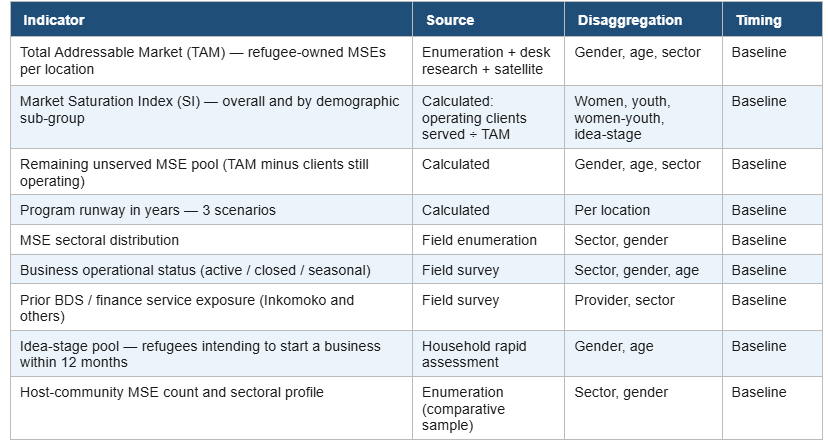
The SI will be calculated at the overall location level and disaggregated by demographic sub-group:
- Women-owned MSEs (primary owner is female)
- Youth-owned MSEs (primary owner aged 18–35)
- Women and youth combined (intersectional)
- Idea-stage pool (economically active refugees intending to start a business within 12 months)
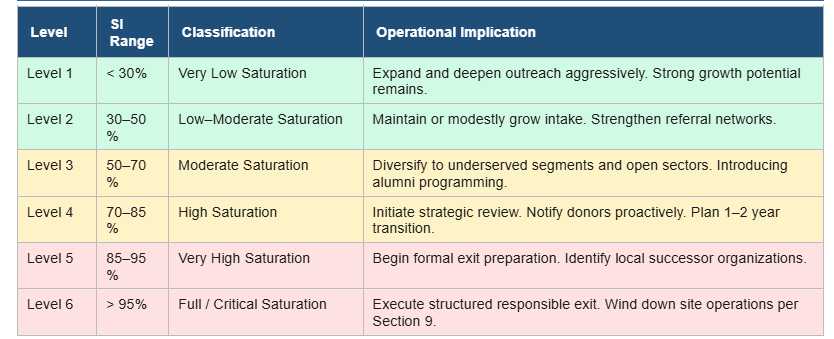
NOTE: The consultant could propose other saturation index ratings based on practical experiences.
3. OBJECTIVES OF THE ASSESSMENT
Overall Objective
To determine the Total Addressable Market of refugee-owned MSEs across Inkomoko Ethiopia's seven operational locations and calculate an evidence-based Saturation Index, generating data sufficient to guide strategic operational decisions through 2030.
Specific Objectives
- Establish the verified TAM of refugee-owned MSEs per location through triangulated desk research, satellite analysis, and field enumeration.
- Calculate the overall SI and demographic sub-group SIs (women, youth, women-youth, idea-stage) for each location.
- Estimate program runway in years under optimistic, baseline, and pessimistic scenarios.
- Map the sectoral composition of MSEs per location to identify crowded and underserved sectors.
- Assess macro-economic and livelihood context, including poverty levels and enabling environment factors.
- Gather stakeholder intelligence on future market trends, planned policy changes, and UNHCR/Gov’t RDP developments.
- Develop location-specific strategic recommendations for saturated locations.
4. SCOPE
The primary focus of this assessment is refugee/IDP-owned MSEs operating in the seven locations i.e Kebribeyah, Awbare, Sheder, Sherkole, Tsore, Bambasi and Addis Ababa. Since host-community entrepreneurs are always present in and around these sites and share the same markets, the assessment will only focus on studying refugee/IDP owned MSEs.
5. METHODOLOGY
The assessment employs a proposed mixed-methods design with four sequential, interlocking phases. Findings are triangulated across all phases before the Saturation Index is finalized.
Phase 1: Desk Research and Secondary Data Analysis
The consultant will review secondary sources to establish a contextual baseline and preliminary TAM estimate for each location before field work begins. Key sources include:
- UNHCR Ethiopia population data portal and Livelihoods and Economic Inclusion reports,
- RRS camp registration and livelihood program records,
- Ministerial, Zonal and Woreda-level Trade, Industry and Market Development Office data on registered enterprises (where available),
- Refugee Registration Stamps (RRS) / RRS work permit records, which provide a partial count of economically active refugees with formalized self-employment,
- WFP food security and household economy assessments (EFSA/mVAM),
- CSA woreda-level population data for host community sizing,
- World Bank / IMF macro-economic indicators for the relevant regions, and
- Other NGO assessments and livelihoods program reports from DRC, IRC, GOAL, Save the Children etc
Inkomoko will share with the consultant aggregated program reports showing the total number of clients served per location from 2022 to 2026, broken down by gender, age group, and business sector. These figures — which exclude any client-level identifying data — will serve as the baseline for the Saturation Index numerator. Client-level data will not be shared.
Phase 2: Satellite and Geospatial Analysis
A geospatial specialist (within the consulting team or sub-contracted) will conduct a pre-field remote sensing analysis of each location using high-resolution satellite imagery (e.g. Google Earth Pro, Planet, or Maxar imagery where available). This serves to: (a) estimate market and commercial zone density before field enumeration begins; (b) identify the boundaries and sub-zones of each camp or settlement for enumeration zone mapping; and (c) provide a cross-check against field enumeration results for anomaly detection after data collection.
The geospatial specialist will deliver: a density heatmap per location showing estimated commercial activity concentration, a zoned enumeration area map for each site (used by field enumerators in Phase 3), and a post-enumeration spatial validation layer comparing enumerated GPS points against satellite-identified commercial structures. The satellite analysis will be presented as a standalone sub-section in the final report.
Phase 3: In-Person Field Enumeration
Trained enumerators will conduct a systematic location-based enumeration (SLE) of all refugee/IDP owned MSEs within each site. Each camp or settlement will be divided into enumeration zones (EZs) derived from the Phase 2 satellite maps and confirmed with camp management and RRS before fieldwork. Enumerators will traverse every EZ and record each identified business using the structured MSE survey (Annex A), administered via KOBO/SurveyCTO on mobile devices with automatic GPS and photo capture.
A household rapid assessment (Annex B) will be administered to a stratified random sample of households per location to estimate non-fixed and home-based MSEs and the idea-stage entrepreneur pool — segments not fully captured by a physical walk-through.
Phase 4: Focus Group Discussions (FGDs) and Key Informant Interviews (KIIs)
Qualitative data collection contextualizes quantitative findings and generates forward-looking stakeholder intelligence. A minimum of two FGDs and three KIIs per location will be conducted (see Annexes C and D for discussion guides):
- FGD 1 — Active refugee business owners (mixed sector, client and non-client)
- FGD 2 — Women and/or youth entrepreneurs, including idea-stage individuals and host community business owners
- KIIs — RRS camp management; UNHCR livelihoods officers; Woreda Trade Office; refugee market association leaders; representatives of other BDS or finance providers in the location
Phase 5: Triangulation and TAM Finalization
Following field work, the assessment team will triangulate: the desk research TAM estimate, the satellite density estimate, the field enumeration count, and Inkomoko's aggregated program reach data. Where divergence between sources exceeds 20%, the consultant will investigate the cause and document the resolution in the methodology section of the final report. The final validated TAM per location will carry a documented confidence range.
6. SAMPLING APPROACH
The consultant must propose a rigorous, well-justified sampling strategy in the Inception Report that clearly links sample design to the assessment's TAM estimation and SI calculation objectives. The strategy must be statistically grounded and must address the specific enumeration characteristics of each location. Minimum requirements are as follows:
- MSE enumeration — Full/Systematic census: Given the geographically bounded nature of refugee camp settings and the availability of zone maps from camp management and Phase 2 satellite analysis, the assessment will apply a full or systematic census approach where any recognized and standard statistical tools and technologies could be leveraged to ensure all representative refugee/IDP MSE enumeration within defined camp boundaries. All MSEs within the EZs will be counted — not a sample — to ensure TAM accuracy. The consultant's sampling plan must justify any deviation from this standard. An experience in conducting such sampling techniques and standards is highly advantageous.
- Household rapid assessment — Stratified random sample: To estimate non-fixed MSEs and the idea-stage pool, a stratified random sample of 150–200 households per location will be drawn from UNHCR/RRS registration lists, stratified by enumeration zone and female-headed household status. The consultant's Inception Report must present full sample size calculations showing the confidence level and margin of error achieved at each site.
- FGDs and KIIs — Purposive sample: Participants will be selected to ensure stakeholder diversity, sectoral range, and inclusion of both Inkomoko clients and non-clients. Selection criteria will be detailed in the Inception Report.
7. KEY INDICATORS
8. DATA VALIDATION AND VERIFICATION
All data collected by the consultant and enumeration team will be subject to the following validation protocols before use in analysis:
- GPS and photographic verification: Every enumerated business will have GPS coordinates and a photograph captured at the point of survey entry. A 15% daily sample of photographs will be reviewed by the field supervisor against the recorded business sector and location. GPS points will be plotted against the Phase 2 satellite map to flag spatial anomalies.
- Back-check protocol: A 10% random back-check sample will be re-interviewed by a supervisor using a 6-question verification instrument. Enumerators with a back-check error rate above 15% in a single day will have that day's work voided and recollected.
- Automated quality controls: SurveyCTO/KoBoToolbox logic will enforce completeness checks, flag records with missing mandatory fields, detect likely duplicates (same GPS within 5m radius), and flag suspiciously short completion times.
- Cross-validation against administrative records: Enumeration counts will be compared with RRS registration data, Woreda Trade Office enterprise records, and RRS permit records where available. Material unexplained discrepancies will be investigated and resolved before finalising the TAM.
- Inkomoko client database reconciliation: Inkomoko's aggregated client reports will be cross-referenced against enumeration data to identify businesses previously served that are now closed (excluded from the SI numerator) and businesses found during enumeration not previously served (remaining pipeline).
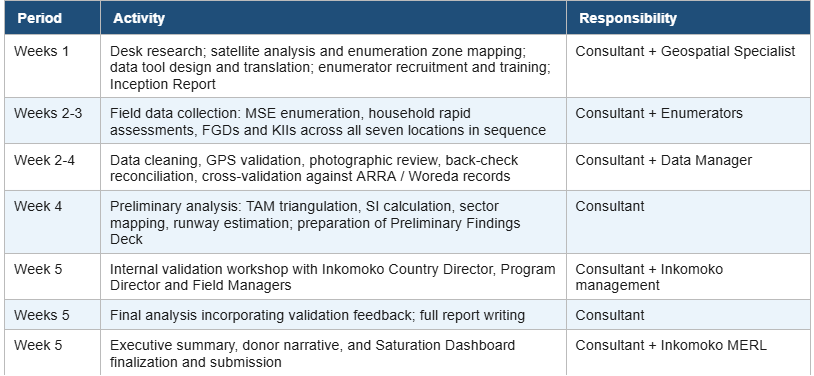
- Validation workshop: Preliminary findings will be presented to Inkomoko's Program Director, MERL Manager and field managers before the report is finalized. Staff field observations that significantly contradict quantitative findings will trigger targeted follow-up investigation.
9. DATA INTERPRETATION AND OPERATIONAL OUTCOMES
Interpretation Approach
The consultant will apply a four-layer analytical framework to each location:
- Layer 1 — SI calculation and classification: The validated TAM is used to calculate the overall SI and demographic sub-group SIs. Each location is assigned a Level 1–6 classification (see Section 2). A cross-site comparative matrix will rank all seven locations.
- Layer 2 — Program runway estimation: Remaining runway will be calculated under three scenarios (optimistic: 80% conversion of remaining pool; baseline: 60% conversion with 10% intake reduction; pessimistic: 40% conversion with 20% intake reduction). Locations will be flagged as: under 2 years (immediate action), 2–4 years (medium-term transition), or above 4 years (operationally stable).
- Layer 3 — Sector-level analysis: Each sector in each location will be classified on a two-axis matrix of penetration rate (low/high) against competitive density (low/high), identifying priority expansion, proceed-with-caution, maintain-and-retain, and exit/pivot sectors.
- Layer 4 — Qualitative contextualization: FGD and KII findings will be synthesized into a concise market potential narrative per location, assessing structural barriers to reaching residual unserved clients and the credibility of any forward-looking pipeline expansion signals.
Strategic Operational Responses
Based on the SI classification and runway estimate, each location will be assigned one of the following strategic postures, with tailored actions:
- Expand and Deepen (SI < 50%): Intensify community outreach; extend to underrepresented zones and demographic segments; grow cohort sizes; invest in idea-stage pipeline development.
- Consolidate and Diversify (SI 50–70%): Shift recruitment focus to underserved demographic segments and open sectors; introduce alumni and second-stage cohorts for program graduates.
- Adapt and Prepare (SI 70–85%): Reduce cohort targets; rationalize site fixed costs; engage donors proactively with assessment evidence; identify and cultivate local transition partners.
- Responsible Exit — Planning (SI 85–95%): Initiate formal exit plan; begin stakeholder consultations; negotiate adjusted donor commitments; formalize handover to a local successor organization.
- Responsible Exit — Execution (SI > 95%): Execute three-phase exit: (i) internal Board decision and exit planning, (ii) stakeholder notification and structured client handover to local MFI and BDS partners, (iii) progressive staff redeployment, site office closure, and formal loan portfolio transfer. Document and disseminate institutional lessons learned.
Where a location scores high overall but retains a materially lower SI for a specific demographic sub-group (e.g. women or youth), the report will identify this as an equity-targeted extension opportunity — a targeted gender- or age-focused cohort may extend viable program life even in an otherwise high-saturation location.
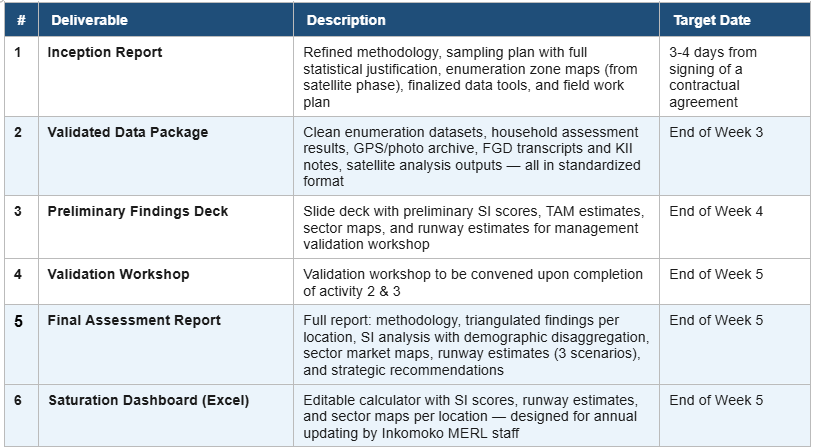
10. EXPECTED DELIVERABLES
11. INDICATIVE TIMELINE
Requirements
12. CONSULTANT PROFILE
Applications are invited from individual consultants or firms with the following minimum qualifications:
- Minimum five years of experience in market assessment, livelihoods programming, or humanitarian economic inclusion in Sub-Saharan Africa, with direct experience in displacement or refugee settings
- Demonstrated experience managing quantitative field data collection, including systematic business enumeration or household surveys in complex operating environments
- A geospatial specialist (in-house or sub-contracted) capable of conducting satellite-based commercial zone density estimation and producing enumeration zone maps
- Familiarity with the Ethiopian refugee context and prior engagement with UNHCR, RRS, or equivalent national refugee authorities
- Proficiency in SurveyCTO/KoBoToolbox (mandatory), GIS analysis tools, and statistical software (SPSS, Stata, or R preferred)
- Excellent written English; proficiency in Somali, Oromo, or Amharic is strongly preferred for direct community engagement
- Portfolio of equivalent market or livelihoods assessment reports available upon request
13. ETHICAL CONSIDERATIONS
- Informed consent: All participants will be informed of the assessment's purpose, the voluntary nature of participation, and how data will be used. Consent will be obtained in the participant's preferred language.
- Data protection: All data will be stored in access-controlled systems. Individual respondent data will not be shared with any third party. Reports will present aggregated data only.
- Do no harm: No data collection activity will expose refugee participants to risk of disclosure of income or business profitability to camp authorities. Enumerators will receive specific sensitivity training.
- Conflict of interest: The consultant and all team members must disclose any relationships with organizations competing with Inkomoko in the assessed locations. Material conflicts must be resolved before field work begins.
Benefits
TO APPLY
Qualified consultants or firms should submit their applications through our online job portal (https://inkomoko-job-portal.web.app/home) or Hand deliver to the Inkomoko Office at Bole Sub City, Mesay Building (Around Edna Mall), 4th Floor by 14th November 2026. Please clearly indicate the consultancy you’re applying for at the right corner of the envelope.
Inkomoko is committed to justice, diversity, equity and inclusion. As we seek to reflect the communities we serve, refugees and women are strongly encouraged to apply. As a company we have policies that ensure fair treatment in the application process.
NB: Only shortlisted candidates/firms will be contacted. Employment is conditional upon successful background checks and other verification as needed.
All offers of employment/consultancy work will be subject to satisfactory references and background screening checks. Inkomoko also participates in the Inter Agency Misconduct Disclosure Scheme, In line with this Scheme, we will request information from job applicants’ previous employers about any findings of sexual misconduct, fraud, or abuse. By applying, the job applicant confirms his/her understanding of these recruitment procedures.
ANNEX A — MSE ENUMERATION SURVEY
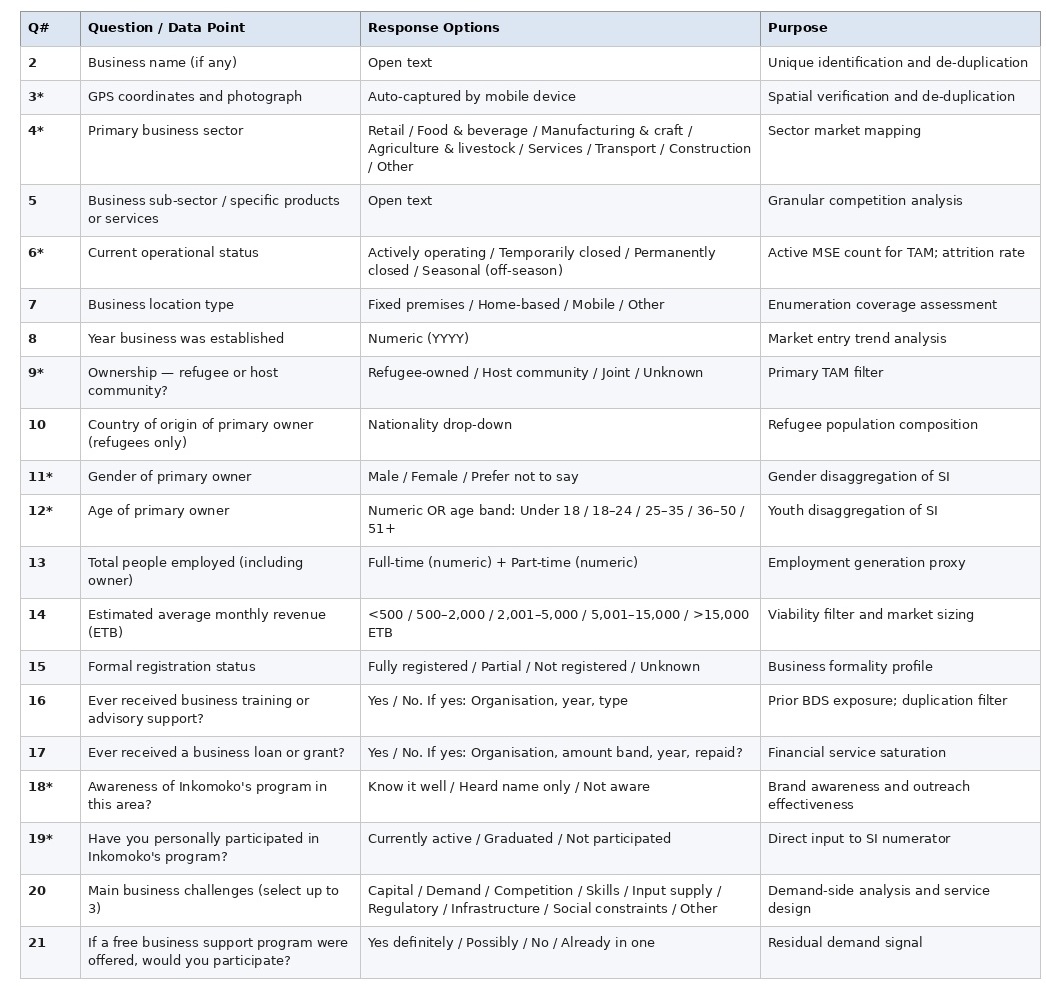
To be administered by enumerators for every MSE identified during field enumeration. Administered via SurveyCTO/KoBoToolbox in local language. Questions marked (*) are mandatory. NOTE: This tool could be fully customized by the consultant upon verification by Inkomoko’s MERL team.
ANNEX B — HOUSEHOLD RAPID ASSESSMENT
Administered to the stratified random household sample (150–200 households per location). Used to estimate home-based and mobile MSEs not captured in the zone walk, and to size the idea-stage entrepreneur pool.
- Does any household member currently own or co-own an active business? (Yes / No). If Yes, administer Annex A (Questions 4–21) for that business.
- Has any household member attempted to start a business in the past 12 months but not succeeded? (Yes / No). If Yes: What was the primary barrier? (Capital / Skills / Work permit / Market uncertainty / Caregiving / Other)
- Is any household member planning to start a business in the next 12 months? (Yes / No). If Yes: What type of business? What support would be most useful?
- Have any household members moved into or out of business ownership in the past 12 months — i.e. opened a new business or permanently closed one? This helps estimate net MSE formation and attrition rates.
ANNEX C — FOCUS GROUP DISCUSSION GUIDE (REFUGEE BUSINESS OWNERS)
Two FGDs per location. Sessions in local language, approximately 45 minutes. Audio-recorded with consent. Facilitated by a trained facilitator with a note-taker.
- Market conditions: How would you describe the business environment in this area over the past 1–2 years? Is it easier or harder to run a business today compared to two years ago, and why?
- Competition and saturation: Have you noticed more businesses similar to yours opening recently? How does increased competition affect your revenues? Which sectors feel overcrowded to you?
- Unmet market needs: Are there products or services that people in this community regularly need but cannot easily find locally? What would it take to start providing those?
- Barriers to business: What are the biggest barriers to starting or growing a business here? Are any of these specific to being a refugee, compared to host-community members?
- Future outlook: Do you plan to expand, maintain, or close your business in the next 12 months? What factors most influence that decision?
- Support services: What business support have you received from any organization? What types of support would still be most useful? What has been most — and least — effective?
ANNEX D — KEY INFORMANT INTERVIEW GUIDE (INSTITUTIONAL STAKEHOLDERS)
A minimum of three KIIs per location targeting: RRS camp management; UNHCR livelihoods officers; Woreda Trade Office; refugee market association leaders; representatives of other BDS or finance providers.
- Market size and trends: How many refugee-owned businesses do you estimate are operating in this area? How has this number changed in the past 2–3 years and why?
- Policy and regulatory environment: Have there been recent or planned changes to work permits, business registration, or other regulations affecting refugees' right to operate businesses?
- Programmatic landscape: Which organizations currently provide BDS or financial support to refugees here? Is there meaningful coordination? Is there significant duplication?
- UNHCR and RDP strategy: What is UNHCR's current strategic direction for refugee livelihoods in this location? Are there planned changes to cash programming, population caseloads, or camp management that could affect MSE density?
- Government economic plans: Are there any government investment plans, market development projects, or infrastructure upgrades planned for this area that could materially affect economic activity levels?
- Future market trajectory: Do you expect the market for refugee-owned MSEs here to grow, stabilize, or decline over the next 3–5 years? What are the main drivers?
POSTING DATE: 04 Nov 2026
RESPONSE DEADLINE : 14 Nov 2026
CONSULTANCY PERIOD: Nov – Dec 2026
CONSULTANCY DAYS: 5-6 Weeks
DEPARTMENT: Monitoring, Evaluation, Research and Learning (MERL) & Business Growth Services
LEVEL: Consultancy – Research Study (Individual Consultant or Firm)
LOCATION: Kebribeyah, Awbare, Sheder, Sherkole, Tsore, Bambasi and Addis Ababa
REPORTS TO: MERL Manager with support from the Program Director